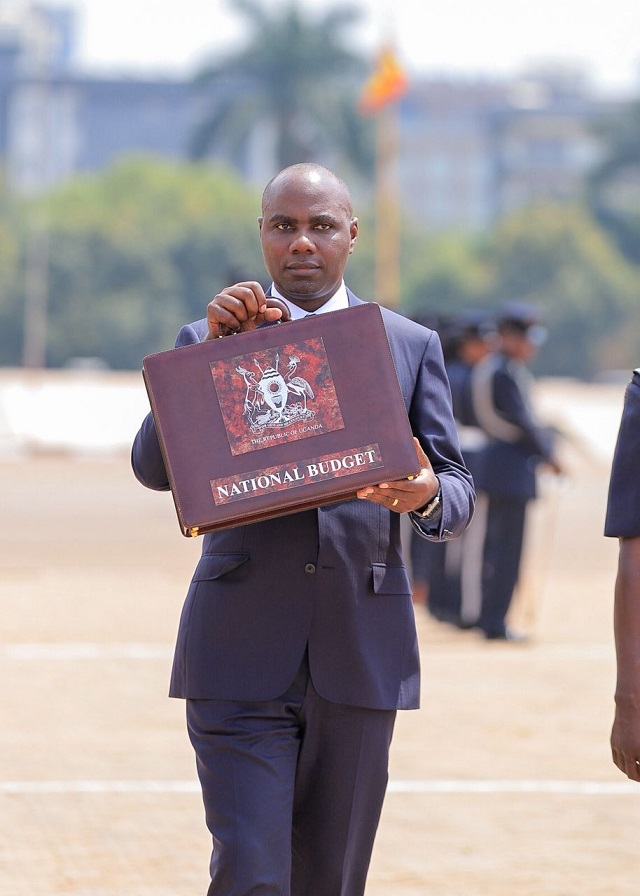
Henry Musasizi read his first budget on June 11
By Julius Businge
KAMPALA — Uganda has unveiled an Shs84.4 trillion national budget for the 2026/27 financial year, setting an ambitious course toward accelerated economic transformation, commercial oil production and implementation of the government’s long-term strategy to grow the economy to USD500 billion by 2040.
Presenting his first budget on June 11 as Minister of Finance, Planning and Economic Development, Henry Musasizi outlined a spending plan anchored on the government’s Tenfold Growth Strategy, which seeks to expand Uganda’s economy nearly tenfold from about USD53 billion in 2025 to USD500 billion within the next 15 years.
The budget comes at a time when Uganda’s economy is estimated to have grown by 6.4% to USD69.3 billion, equivalent to approximately Shs250.4 trillion in nominal terms, with government projecting even faster expansion in the coming financial year.
Musasizi said the country is entering a new phase of economic development characterised by industrialisation, value addition, mineral development, export growth and the anticipated start of commercial oil production.
...
Henry Musasizi read his first budget on June 11
By Julius Businge
KAMPALA — Uganda has unveiled an Shs84.4 trillion national budget for the 2026/27 financial year, setting an ambitious course toward accelerated economic transformation, commercial oil production and implementation of the government’s long-term strategy to grow the economy to USD500 billion by 2040.
Presenting his first budget on June 11 as Minister of Finance, Planning and Economic Development, Henry Musasizi outlined a spending plan anchored on the government’s Tenfold Growth Strategy, which seeks to expand Uganda’s economy nearly tenfold from about USD53 billion in 2025 to USD500 billion within the next 15 years.
The budget comes at a time when Uganda’s economy is estimated to have grown by 6.4% to USD69.3 billion, equivalent to approximately Shs250.4 trillion in nominal terms, with government projecting even faster expansion in the coming financial year.
Musasizi said the country is entering a new phase of economic development characterised by industrialisation, value addition, mineral development, export growth and the anticipated start of commercial oil production.
The government expects Uganda to begin producing and selling crude oil during the first quarter of FY2026/27, generating an estimated Shs1.4 trillion in oil revenues and ending a 17-year wait since the discovery of commercially viable petroleum deposits.
The minister described the development as a major milestone that will strengthen domestic revenue mobilisation and support investment in priority sectors.
He noted that construction of the East African Crude Oil Pipeline (EACOP) and the central processing facilities is nearing completion, positioning the country for first oil production.
Beyond petroleum, government is also accelerating efforts to unlock value from Uganda’s mineral resources. Ongoing assessments of uranium, manganese and lithium deposits are expected to support future investments in mining and industrial development.
Musasizi cited the commissioning of a clinker factory in Moroto District as an example of government’s efforts to promote local value addition in the minerals sector and reduce dependence on imported industrial inputs.
The minister also expressed confidence that Uganda remains on course to graduate from the category of Least Developed Countries by March 2027, a move expected to enhance the country’s investment attractiveness and lower sovereign risk.
“Our objective is to position Uganda as a highly competitive and self-determined economy capable of attracting quality international investment and creating sustainable prosperity for its people,” Musasizi said.
The budget will be financed through a combination of domestic revenue, oil receipts, grants and borrowing.
Government projects domestic revenue collections of Shs45.6 trillion, up from Shs35.7 trillion realised in FY2025/26. The projected revenue comprises Shs40.1 trillion in tax collections, Shs4 trillion in non-tax revenues and Shs1.4 trillion from oil revenues.
According to the ministry, the increase will be driven by stronger economic activity, improved tax administration by the Uganda Revenue Authority, enforcement measures and the commencement of commercial oil production.
External financing is projected at Shs12.5 trillion, including Shs1.2 trillion in budget support and Shs11.3 trillion for development projects.
Government also plans to raise approximately Shs12 trillion through domestic borrowing, although authorities indicated that borrowing will gradually decline as part of efforts to strengthen fiscal sustainability.
Uganda’s total public debt stood at USD34.86 billion, equivalent to approximately Shs126.19 trillion, as of December 2025. This translates into a debt-to-GDP ratio of about 53%.
External debt amounted to USD15.84 billion while domestic debt stood at USD19 billion.
The spending plan places significant emphasis on the ATMS growth strategy — Agro-Industrialisation, Tourism Development, Minerals including Oil and Gas, and Science, Technology and Innovation — which government considers the key drivers of future economic growth.
Agro-industrialisation emerged as one of the biggest beneficiaries, receiving a record allocation of Shs2.26 trillion.
The resources will support agricultural research and innovation, irrigation infrastructure, water for production, extension services, provision of quality agricultural inputs, post-harvest handling, agro-processing and expansion of market access opportunities.
Government says the allocation is intended to boost productivity, enhance value addition and increase household incomes in a sector that remains the largest employer in the country.
Science, Technology and Innovation, including the creative industry, received Shs1.14 trillion.
Priority investments will focus on commercialisation of locally developed innovations such as Kiira Motors vehicles, Dei BioPharma pharmaceuticals and vaccines, coffee products and banana-based industrial products.
Additional funding will support the establishment of a Hi-Tech City, expansion of digital infrastructure and growth of the Business Process Outsourcing industry as a source of employment for young people.
Tourism was allocated Shs567 billion to support destination marketing, tourism infrastructure, hospitality standards, conservation initiatives and development of health tourism.
Government is also targeting stronger economic diplomacy and improved tourism facilities to increase visitor arrivals and foreign exchange earnings.
The Minerals, Oil and Gas sector received Shs473.5 billion to support mineral exploration, certification, establishment of mineral buying centres, operationalisation of EACOP and development of Uganda’s oil refinery.
Beyond the ATMS priorities, infrastructure remains central to government’s development agenda.
Transport infrastructure is expected to continue receiving substantial investment through roads, bridges, airports and railway projects aimed at improving connectivity and lowering the cost of doing business.
Musasizi said government will also continue supporting wealth creation initiatives, noting that cumulative investment in such programmes has now reached Shs11 trillion.
The Parish Development Model alone is expected to reach more than four million beneficiaries by the end of June 2026.
A key feature of the 2026/27 budget is government’s renewed focus on implementation discipline and accountability.
Musasizi announced a comprehensive public sector reform programme targeting waste, corruption, delays and inefficiencies that have historically undermined service delivery.
Beginning in FY2026/27, all Accounting Officers will be required to sign Budget Discipline and Accountability Charters as part of their performance contracts.
The charters will provide sanctions for violations related to planning, budgeting and execution of public resources.
Government also plans to strengthen procurement systems, digitise public service processes, reinforce internal controls and improve transparency across public institutions.
As part of expenditure rationalisation measures, state-funded celebrations on public holidays will be suspended, except for religious functions.
The minister said the move is intended to redirect resources toward productive investments while promoting greater efficiency in public spending.
The 2026/27 budget therefore represents more than a financing plan. It reflects government’s attempt to reposition Uganda’s economy around productive sectors, export-led growth, industrialisation and emerging oil revenues.
Whether the ambitious targets are achieved will largely depend on implementation discipline, efficient utilisation of public resources and government’s ability to translate macroeconomic gains into jobs, incomes and improved living standards for ordinary Ugandans.