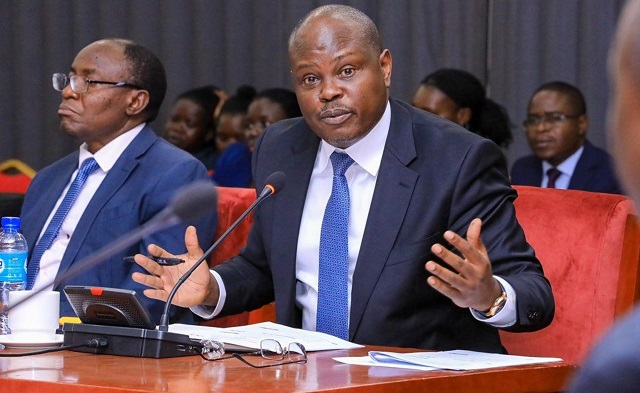
Auditor General, Edward Akol
By our reporter
A new government audit has laid bare profound weaknesses in the Parish Development Model (PDM), raising serious questions about oversight, transparency and the programme’s ability to deliver on its promise of lifting millions of Ugandans out of poverty.
The Auditor General’s latest report, covering implementation through the 2024 and 2025 financial years, reveals that despite massive public spending and political emphasis on the initiative, Uganda’s flagship poverty-alleviation programme remains riddled with mismanagement, irregularities and empty promises.
The PDM was launched by the ruling government as a transformative strategy to transition households from subsistence to a money-economy. At its core is a Parish Revolving Fund intended to inject financial capital into savings and credit cooperative societies (SACCOs) at the grassroots, enabling community-driven investment in enterprises, agriculture and local development.
However, the Auditor General’s findings show that the machine designed to empower citizens may be failing those very communities.
...
Auditor General, Edward Akol
By our reporter
A new government audit has laid bare profound weaknesses in the Parish Development Model (PDM), raising serious questions about oversight, transparency and the programme’s ability to deliver on its promise of lifting millions of Ugandans out of poverty.
The Auditor General’s latest report, covering implementation through the 2024 and 2025 financial years, reveals that despite massive public spending and political emphasis on the initiative, Uganda’s flagship poverty-alleviation programme remains riddled with mismanagement, irregularities and empty promises.
The PDM was launched by the ruling government as a transformative strategy to transition households from subsistence to a money-economy. At its core is a Parish Revolving Fund intended to inject financial capital into savings and credit cooperative societies (SACCOs) at the grassroots, enabling community-driven investment in enterprises, agriculture and local development.
However, the Auditor General’s findings show that the machine designed to empower citizens may be failing those very communities.
According to the report, only a fraction of allocated funds has reached intended beneficiaries. Of more than Shs3tn disbursed cumulatively to more than 10,500 PDM SACCOs across Uganda, only about Shs2.7tn, or 84 percent, was actually distributed to households. The balance reportedly remains idle in accounts at various administrative levels, with no clear plan for accountability or recovery.
The slow pace of fund movement has raised alarm among lawmakers and civil society, with Parliament’s Speaker emphasising that budget appropriations should translate into real community impact, not stagnating cash. Calls for tougher audits and enforcement were echoed in legislative chambers in Kampala.
The audit also unearthed widespread irregularities in loan disbursements, with multiple reports detailing how individuals received duplicate or excessive loans in contravention of programme guidelines. Some cases involved people with identical National Identification Numbers receiving multiple loans, while in others, the same household was recorded to receive multiple allocations well beyond the maximum allowed.
Crucially, tens of thousands of beneficiaries under the programme have not secured required agricultural insurance, leaving them exposed to climate-related shocks and undermining the very resilience the PDM is supposed to support. The insurance gap, spanning more than 19,000 farmers, has been attributed to inadequate guidance and limited funding for Uganda’s Agriculture Insurance Scheme.
Another troubling pattern highlighted in the audit is the failure to properly register enterprise groups and SACCOs. Thousands of cooperative groups funded under the PDM lack formal legal registration, exposing government funding to potential loss due to illegitimacy. The report noted that many SACCOs lack physical offices, registered identities, or basic documentation, challenges that impede traceability and accountability.
The Auditor General emphasised that monitoring and evaluation frameworks for the PDM remain underdeveloped, with key performance indicators absent at subnational levels. This has made it difficult to track progress, measure outcomes or assess whether the programme is succeeding in its core objectives.
Critics contend that this governance vacuum not only risks public funds but also undermines confidence in government-driven poverty reduction. Communities have voiced scepticism over the programme’s value, with some attributing weak uptake to poor communication, inadequate budgeting for essential tasks like registration, and logistical constraints.
The issues go beyond bookkeeping. By failing to build a robust system for oversight, the programme effectively leaves vulnerable Ugandans exposed to financial exclusion, reinforcing the very inequities it was supposed to address.
The audit also underlined broader implementation gaps, including failure to complete household data collection and population registration, which are critical for targeting beneficiaries and tracking impact at community level.
Opposition voices and civil society advocates say the Auditor General’s revelations underscore the necessity for urgent reform. They argue that without correcting foundational issues in governance, legal compliance, registration, insurance coverage and monitoring, the Parish Development Model could become a costly but hollow policy exercise.
Government officials have acknowledged the concerns and indicated plans to strengthen oversight and tighten enforcement measures. Lawmakers have also called for deeper investigations and consequences for officials responsible for mismanagement and diversion of funds.
As Uganda heads into another fiscal cycle, the PDM’s future hinges on whether authorities can translate audit revelations into concrete reforms, not only to safeguard state resources, but more importantly, to restore public confidence and ensure that the intended beneficiaries genuinely benefit from one of the country’s most politically prominent development programmes.