By Julius Businge
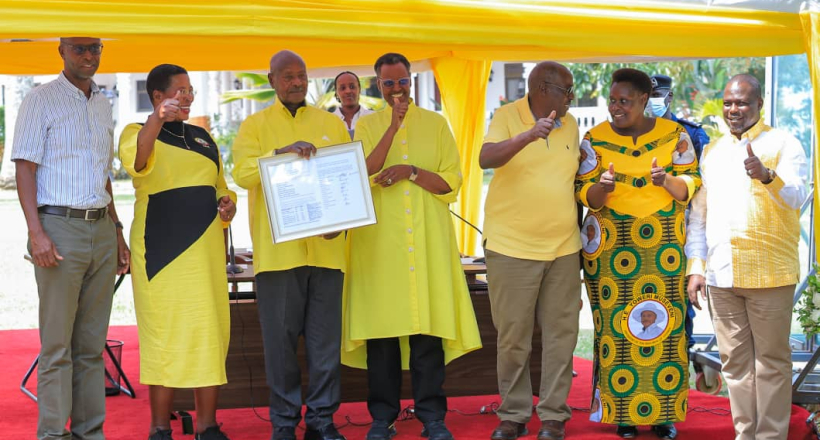
President-elect Yoweri Kaguta Museveni’s post-election address from his country home in Rwakitura was more than a thanksgiving speech. It was a carefully calibrated political economy statement, linking electoral legitimacy, security authority and economic strategy as the foundations of Uganda’s next governance cycle.
By crediting God, the National Resistance Movement (NRM) and Uganda’s security institutions for his victory, Museveni placed the election outcome within a familiar triad of divine sanction, party machinery and coercive stability. This framing underscored how political power, institutional control and economic direction remain tightly intertwined in Uganda’s post-election order.
The President-elect thanked NRM leaders and campaign structures for mobilising support while singling out the armed forces for preserving peace during a tense electoral period. He also acknowledged religious and cultural leaders, positioning them as stabilising actors in a political system where legitimacy is drawn not only from ballots but from social authority and order.
...
By Julius Businge
President-elect Yoweri Kaguta Museveni’s post-election address from his country home in Rwakitura was more than a thanksgiving speech. It was a carefully calibrated political economy statement, linking electoral legitimacy, security authority and economic strategy as the foundations of Uganda’s next governance cycle.
By crediting God, the National Resistance Movement (NRM) and Uganda’s security institutions for his victory, Museveni placed the election outcome within a familiar triad of divine sanction, party machinery and coercive stability. This framing underscored how political power, institutional control and economic direction remain tightly intertwined in Uganda’s post-election order.
The President-elect thanked NRM leaders and campaign structures for mobilising support while singling out the armed forces for preserving peace during a tense electoral period. He also acknowledged religious and cultural leaders, positioning them as stabilising actors in a political system where legitimacy is drawn not only from ballots but from social authority and order.
Yet beneath the tone of gratitude lay an admission of vulnerability. Museveni revealed that voter turnout had fallen sharply, estimating that about 10 million registered voters did not cast ballots. For a ruling party that has governed for four decades, low participation presents a political economy challenge: maintaining consent while managing fatigue, demographic change and economic pressure.
Museveni said the NRM would interrogate the reasons for the low turnout, calling it a test of the party’s organisational strength. He further noted that a significant number of spoiled votes came from NRM supporters, particularly elderly voters, suggesting institutional weaknesses in mobilisation and voter education that could affect future political bargaining power.
Security featured prominently, reinforcing the central role of the state’s coercive apparatus in Uganda’s governance model. Museveni warned against violence and electoral disruption, citing attempts by armed groups to interfere with polling in some areas. He framed stability as a prerequisite for economic progress, cautioning that disorder could push Uganda toward outcomes witnessed in conflict-affected states such as Libya.
This linkage between peace and prosperity is a recurring motif in Museveni’s political economy narrative: security enables investment, investment drives growth, and growth sustains political authority. It is a logic that has guided Uganda’s development strategy since the late 1980s.
Looking ahead to the next kisanja, Museveni outlined an economic approach anchored in dual priorities: supporting wealth creators while directly intervening to lift the poorest households out of subsistence. The strategy reflects an attempt to balance elite accumulation with mass inclusion, a tension that has long defined Uganda’s economic governance.
On one side of the ledger are commercial farmers, industrialists, hotel owners and investors, whom Museveni described as engines of growth. Institutions such as the Uganda Development Bank are expected to continue providing long-term, subsidised capital to these actors, reinforcing a state-guided model of private sector expansion.
On the other side is the Parish Development Model (PDM), which has become the flagship political economy intervention at household level. Museveni framed the programme not only as an anti-poverty tool but as a mechanism to reduce political vulnerability, arguing that economically secure households are less susceptible to manipulation and unrest.
Skilling hubs and parish-level financing, he said, have already generated hope among communities and would be strengthened. The message was clear: economic inclusion is being pursued not just for welfare reasons, but as a stabilising strategy in a competitive political environment.
Social services also featured prominently, reflecting the distributive dimension of Museveni’s governance agenda. The President-elect reaffirmed commitments to free education in government schools and improved healthcare delivery, while warning against corruption and leakage in drug supply chains. He singled out the judiciary and road contractors, signalling tougher oversight in sectors that directly affect citizen trust and everyday economic life.
Corruption and injustice, Museveni acknowledged, continue to anger citizens. His pledge of tougher action speaks to a broader political economy concern: unchecked rent-seeking undermines both service delivery and the credibility of state authority, especially at a time of rising fiscal pressure.
The most consequential economic signal, however, lay in Museveni’s remarks on oil. Confirming that Uganda is entering the production phase, he emphasised that petroleum revenues would be treated as a strategic, exhaustible resource rather than a fiscal windfall.
Oil income, Museveni said, would be invested in long-term infrastructure such as railways, power generation and science-based education. The objective is to convert underground wealth into productive national assets that outlast the oil itself. This reflects lessons drawn from resource-rich states where consumption-led spending has failed to generate durable development.
The emphasis on infrastructure and science aligns with Uganda’s long-term ten-fold growth strategy, which targets transforming the economy into a high-income system valued at about $500 billion by 2040. Museveni framed his re-election as a renewed mandate to accelerate this transformation, coupling political continuity with economic ambition.
Macroeconomic conditions provide a relatively stable backdrop to this agenda. Uganda’s economy grew by about 6.3 percent in the financial year ending June 2025, supported by agriculture, construction, manufacturing and services. Inflation remained contained at roughly 3.5 percent, within the central bank’s target range.
Government projections place nominal GDP at nearly $66 billion in 2026, with per capita income estimated at about $1,338. Medium-term frameworks target growth above 8 percent annually, driven by investment, oil production and productivity gains. For investors, Museveni’s message signalled policy continuity, fiscal discipline and a state committed to crowding in private capital.
Wealth creation at household level remains central to this vision. By mid-2025, government disbursements under the Parish Development Model had exceeded Shs3.3 trillion, reaching more than 10,000 parishes and benefiting over 2.6 million people. From a political economy perspective, this represents both social protection and demand creation, expanding rural purchasing power and integrating subsistence households into the money economy.
Regional trade also featured as a strategic pillar. Uganda continues to position itself within the East African Community and the African Continental Free Trade Area, expanding market access beyond domestic limits. Improved transport links, harmonised trade rules and digital customs systems are expected to support exporters and manufacturers seeking scale.
Capital formation is rising, with gross fixed capital formation exceeding Shs42 trillion in 2024 and projected to surpass Shs45 trillion by 2026. These investments underpin long-term productivity but also increase the stakes for governance, debt management and efficient execution.
Museveni’s address also touched on governance reform, promising tighter supervision, tougher action against non-performers and improved efficiency in land administration, justice and utilities. For businesses, these reforms influence transaction costs, investment security and predictability — critical variables in capital allocation decisions.
Despite the optimistic tone, structural risks remain. Uganda continues to run a sizeable current account deficit, highlighting the need for export diversification, higher domestic savings and deeper value addition. Climate vulnerability, urban infrastructure strain and skills mismatches also require coordinated responses from both state and market actors.
In closing, Museveni saluted all Ugandans, including opposition supporters, calling for unity as the country enters a new term. The First Lady, Janet Museveni, reinforced the spiritual framing of the victory, urging leaders and supporters to recommit to service.
Taken together, Museveni’s victory message offered a concise blueprint of Uganda’s evolving political economy: a state anchored in security, seeking legitimacy through growth and inclusion, and betting on infrastructure, oil and regional trade to sustain both prosperity and power in the years ahead.