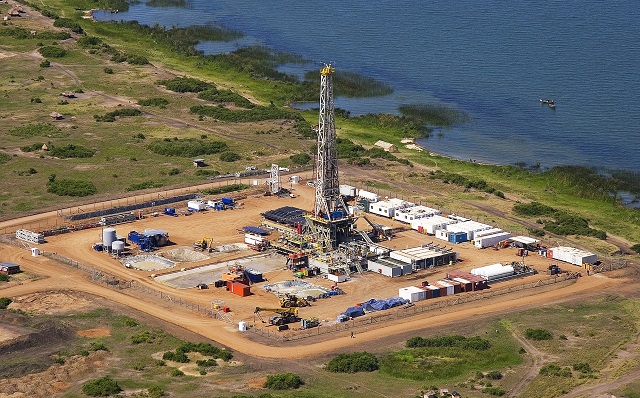
The Kingfisher well, Block 3A
By Julius Businge
Uganda has stepped up pressure on international oil companies to meet critical milestones as the country moves closer to its long-awaited entry into commercial oil production, with government leaders reiterating that “first oil” must be delivered within the revised 2026 timeline.
Energy and Mineral Development Minister Ruth Nankabirwa recently reminded oil companies operating in Uganda’s Albertine Graben that delays would no longer be tolerated, stressing that government expectations are now firmly anchored on delivery rather than projections. Her remarks followed inspections of key oil and gas infrastructure, including upstream fields, pipeline corridors and industrial facilities supporting the sector.
Uganda’s oil journey, spanning more than two decades since the discovery of commercially viable reserves, has been marked by repeated shifts in timelines driven by financing complexities, infrastructure demands and regulatory negotiations. However, government officials say the current phase represents a turning point, with most foundational investments now well advanced and the sector transitioning toward commissioning and operational readiness.
...
The Kingfisher well, Block 3A
By Julius Businge
Uganda has stepped up pressure on international oil companies to meet critical milestones as the country moves closer to its long-awaited entry into commercial oil production, with government leaders reiterating that “first oil” must be delivered within the revised 2026 timeline.
Energy and Mineral Development Minister Ruth Nankabirwa recently reminded oil companies operating in Uganda’s Albertine Graben that delays would no longer be tolerated, stressing that government expectations are now firmly anchored on delivery rather than projections. Her remarks followed inspections of key oil and gas infrastructure, including upstream fields, pipeline corridors and industrial facilities supporting the sector.
Uganda’s oil journey, spanning more than two decades since the discovery of commercially viable reserves, has been marked by repeated shifts in timelines driven by financing complexities, infrastructure demands and regulatory negotiations. However, government officials say the current phase represents a turning point, with most foundational investments now well advanced and the sector transitioning toward commissioning and operational readiness.
At the centre of the push are the Tilenga and Kingfisher upstream projects, operated by TotalEnergies and CNOOC respectively. The Tilenga project, located in Buliisa District, has recorded substantial progress in drilling activity, with a significant proportion of planned production wells already completed. Officials say improvements in drilling efficiency have reduced costs and time, increasing confidence that field development targets can be met.
The Kingfisher project in Kikuube District is also advancing, supported by central processing facilities designed to handle Uganda’s waxy crude. Together, the two projects are expected to produce over 200,000 barrels of oil per day at peak output, positioning Uganda as a notable new producer in sub-Saharan Africa.
Midstream infrastructure remains a critical component of the first oil equation. Construction of the East African Crude Oil Pipeline (EACOP), which will transport Uganda’s crude oil to the Tanzanian port of Tanga for export, continues across both countries. The 1,443-kilometre heated pipeline is one of the most ambitious infrastructure projects in the region and is viewed by government as essential to unlocking Uganda’s petroleum revenues.
Officials report steady progress on pipeline construction, pump stations and feeder lines linking production fields to the main export route. Ugandan authorities have repeatedly emphasized that alignment between upstream development and pipeline readiness is crucial to avoiding bottlenecks once production begins.
Uganda’s recoverable oil reserves have also been revised upwards following additional appraisal and development drilling. Latest estimates place recoverable resources at approximately 1.65 billion barrels, strengthening the economic case for large-scale investment and underpinning long-term production forecasts.
Beyond exports, the government continues to pursue plans for a domestic oil refinery in Hoima District, intended to process part of Uganda’s crude for local and regional consumption. The proposed refinery, with a planned capacity of 60,000 barrels per day, is expected to reduce fuel imports, stabilize domestic supply and deepen value addition within the country. Negotiations with investors are ongoing as government seeks to balance commercial viability with strategic energy security goals.
From a macroeconomic perspective, Uganda views oil revenues as a catalyst for structural transformation rather than a source of short-term consumption. Government policy statements consistently indicate that proceeds from oil production will be directed toward long-term investments, including transport infrastructure, electricity generation, industrial parks and science-based education.
Finance officials have estimated that once production stabilizes, the oil sector could generate between one and two and a half billion dollars annually, depending on global prices and production profiles. These revenues are expected to complement existing growth drivers such as agriculture, manufacturing and services, rather than replace them.
Nevertheless, risks remain. Global oil price volatility, environmental concerns, financing constraints and community expectations continue to shape the operating environment. Government has sought to manage these risks through regulatory oversight, environmental safeguards and local content policies aimed at increasing Ugandan participation in the sector.
The Petroleum Authority of Uganda and other agencies are also strengthening monitoring frameworks to ensure compliance with safety, environmental and operational standards as the sector approaches production.
As the countdown to first oil continues, Uganda’s oil and gas industry stands at a decisive moment. After years of anticipation, planning and negotiation, the emphasis has shifted firmly to execution. For government, investors and citizens alike, the coming months will determine whether Uganda can finally convert its petroleum resources into a sustainable engine for national development.