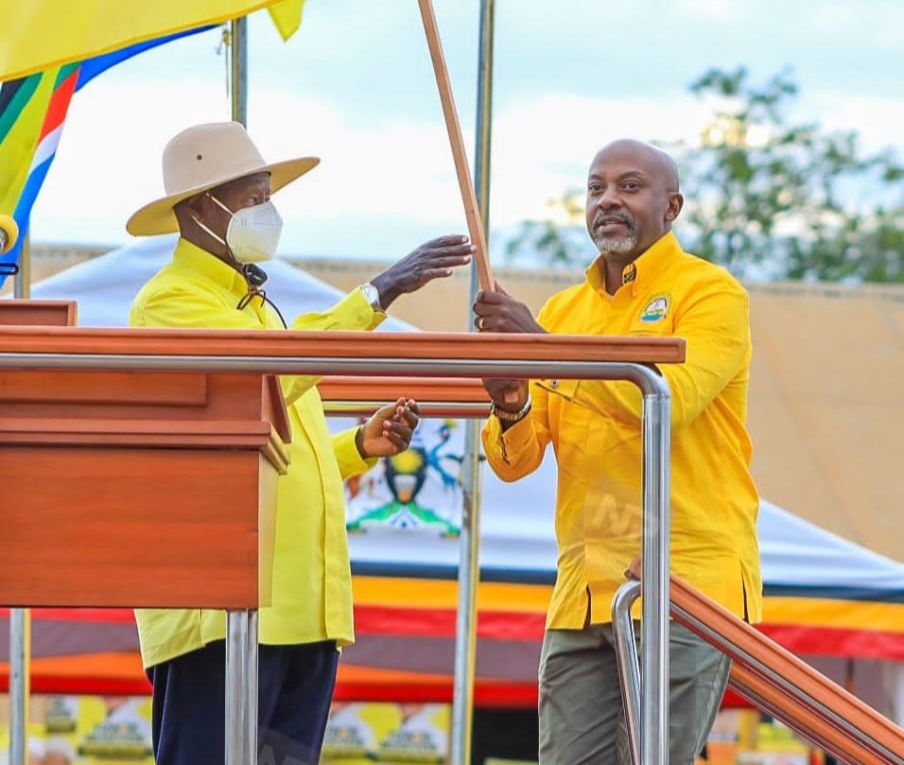
President Museveni hands over the NRM party flag to Dedan Mubangizi, officially endorsing him as the party’s flag bearer
By Our Reporter
Dedan Mubangizi’s eventual victory in the Buwekula South parliamentary contest, confirmed after a court-ordered recount, unfolded against the backdrop of a tense and controversial general election.
Nationally, the polls were characterized by widespread allegations of voter bribery, ballot stuffing, failures of the biometric voter verification system, clashes between opposition supporters and security agencies, and internal disputes within political parties.
These conditions deepened public distrust in electoral processes and shifted voter focus toward candidates with proven records of engagement rather than those relying on party strength or election-day mobilization.
...
President Museveni hands over the NRM party flag to Dedan Mubangizi, officially endorsing him as the party’s flag bearer
By Our Reporter
Dedan Mubangizi’s eventual victory in the Buwekula South parliamentary contest, confirmed after a court-ordered recount, unfolded against the backdrop of a tense and controversial general election.
Nationally, the polls were characterized by widespread allegations of voter bribery, ballot stuffing, failures of the biometric voter verification system, clashes between opposition supporters and security agencies, and internal disputes within political parties.
These conditions deepened public distrust in electoral processes and shifted voter focus toward candidates with proven records of engagement rather than those relying on party strength or election-day mobilization.
Buwekula South has historically reflected this skepticism. For decades, the constituency consistently elected independent legislators, signaling resistance to formal party structures and a preference for individuals perceived as accountable to local communities. Even Mubangizi’s closest challenger, Fred Tumwesigye, whose initial declaration as winner was later nullified by court over electoral irregularities, contested as an independent. Within this context, Mubangizi’s emergence as one of the few National Resistance Movement MPs from Buganda, a region increasingly associated with opposition politics under the National Unity Platform, marked a notable departure from established voting patterns.
Observers of the race point out that this shift was shaped well before the election period. Long before nominations and campaign rallies, Mubangizi had invested time and resources into sustained grassroots engagement. Beginning around 2022, his presence across villages and parishes became increasingly visible, focusing on service delivery rather than political messaging.
Healthcare interventions stood out as a central component of this approach. In July 2024, a three-day medical outreach in Kibyamirizi, sponsored by Mubangizi, treated more than 10,000 residents, offering eye care, dental services, general treatment, and free medication. The outreach was reinforced by longer-term support to local health facilities, including the donation of ultrasound machines, delivery beds, and patient beds to Kitenga Health Centre III, as well as earlier efforts that helped secure an ambulance and CT scan equipment for the Health Centre IV. For many residents, these actions contrasted sharply with the transactional politics that dominated the broader election season.
Education support further strengthened his local standing. Mubangizi assisted individual learners to remain in school, provided scholastic materials, and contributed to improving school infrastructure. In November 2024, he played a leading role in a fundraising drive that raised 120 million shillings toward the construction of St. Mark Kayebe Secondary School, the only secondary school in Kayebe parish. Community leaders, parents, and teachers frequently referenced this intervention as evidence of long-term commitment rather than election-driven generosity.
His engagement extended into the economic sphere, particularly agriculture. As a dairy farmer, Mubangizi consistently purchased milk from farmers throughout the constituency, creating a dependable market and embedding himself in the daily economic life of the community. This regular interaction fostered familiarity and trust that are often difficult to achieve through campaign appearances alone.
Infrastructure development also featured prominently. Community mobilization to clear and rehabilitate feeder roads improved access to markets and eased the transportation of agricultural produce. In many instances, these efforts involved direct participation alongside residents, reinforcing a sense of shared responsibility and ownership.
Youth outreach, especially through sports, played a quieter but significant role. Football tournaments and support for youth teams created informal spaces for interaction with young voters, many of whom felt alienated from traditional political structures. Rather than serving as campaign spectacles, these activities became ongoing social platforms.
By the time nominations were formally undertaken, Mubangizi was already widely regarded within Buwekula South as a familiar and dependable figure. When the election results were challenged and a recount ordered, the court’s final declaration aligned with perceptions that had been shaped long before polling day.
In a general election marked by controversy, confrontation, and weakened public confidence, the Buwekula South outcome highlighted the political value of sustained grassroots engagement. Mubangizi’s victory demonstrated that in constituencies with a strong tradition of independence, long-term presence and practical service can outweigh party labels, financial inducements, and short-term electoral tactics.