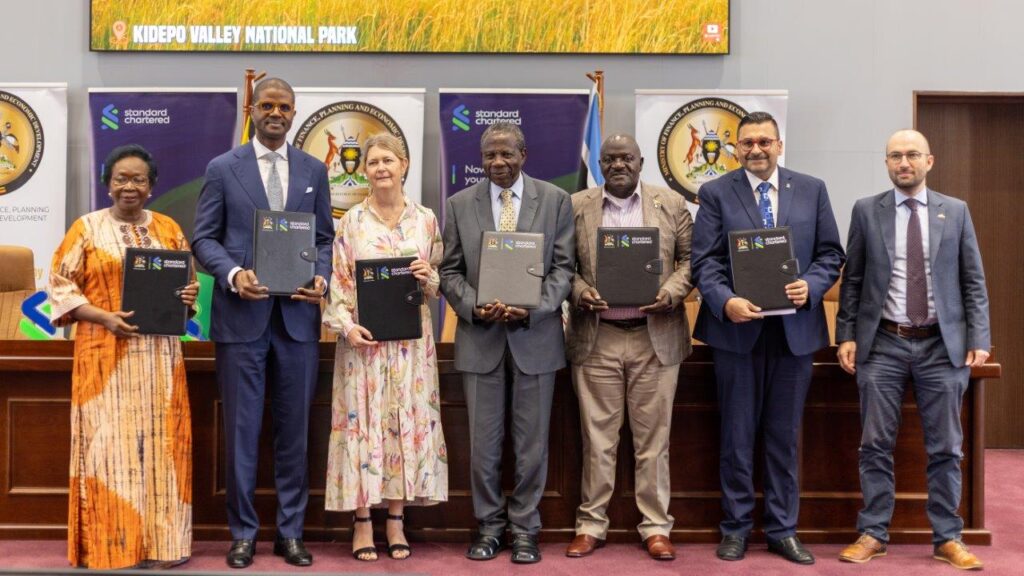
Officials pose for a group photo with the signed agreements
By Our Reporter
The Ugandan government has deepened its reliance on international banking and export credit institutions to drive its long-term growth agenda, signing infrastructure financing agreements worth Shs2.747 trillion with Standard Chartered Bank Uganda in a deal that underscores the central role of debt-backed capital in the country’s development strategy.
The agreements, signed on January 30, 2025, at the Ministry of Finance, Planning and Economic Development, commit external financing to power transmission, water and sanitation, and road construction—sectors the government views as binding constraints to economic expansion. Finance Minister Matia Kasaija signed on behalf of the government, while Standard Chartered Uganda chief executive Sanjay Rughani represented the bank.
The deal comes as Uganda seeks to accelerate implementation of its Ten-Fold Growth Strategy, which aims to expand the economy to about $500 billion by 2040. With domestic revenues still limited relative to infrastructure needs, the government has increasingly turned to blended financing structures involving commercial banks, export credit agencies and multilateral insurers to close funding gaps.
...
Officials pose for a group photo with the signed agreements
By Our Reporter
The Ugandan government has deepened its reliance on international banking and export credit institutions to drive its long-term growth agenda, signing infrastructure financing agreements worth Shs2.747 trillion with Standard Chartered Bank Uganda in a deal that underscores the central role of debt-backed capital in the country’s development strategy.
The agreements, signed on January 30, 2025, at the Ministry of Finance, Planning and Economic Development, commit external financing to power transmission, water and sanitation, and road construction—sectors the government views as binding constraints to economic expansion. Finance Minister Matia Kasaija signed on behalf of the government, while Standard Chartered Uganda chief executive Sanjay Rughani represented the bank.
The deal comes as Uganda seeks to accelerate implementation of its Ten-Fold Growth Strategy, which aims to expand the economy to about $500 billion by 2040. With domestic revenues still limited relative to infrastructure needs, the government has increasingly turned to blended financing structures involving commercial banks, export credit agencies and multilateral insurers to close funding gaps.
The largest share of the financing will support electricity transmission infrastructure, a critical link in Uganda’s energy value chain. A facility of EUR 342.5 million will fund construction of the 400KV Karuma–Tororo double-circuit transmission line and the Ntinda substation. The project is intended to enable full evacuation of power from the Karuma Hydropower Plant, reduce transmission bottlenecks and stabilise supply to industrial and urban centres.
Despite heavy public investment in generation capacity over the past decade, Uganda has continued to lose potential revenue due to underdeveloped transmission infrastructure. Government officials argue that strengthening the grid is essential for industrialisation, export competitiveness and attracting energy-intensive investors. The financing for the power project is backed by Swedish export credit institutions, marking their first transaction in Uganda and reflecting growing international confidence in the country’s infrastructure pipeline.
Water and sanitation form the second pillar of the financing package, with EUR 182.8 million allocated to Phase II of the Strategic Towns Water Supply and Sanitation Project. Covering Nakasongola District and clusters in eastern and northern Uganda, the project is expected to extend access to clean water and sanitation services to hundreds of thousands of people by 2030. The government views the investment as both a social and economic intervention, linking public health outcomes to labour productivity and long-term human capital development. The facility is supported by China’s export credit insurer, Sinosure, continuing Beijing’s role in financing Uganda’s basic infrastructure.
The third facility, valued at EUR 115.8 million, will finance road construction in the Albertine region, including the Karugutu–Ntoroko road, the Rwebisengo link road and town roads in Ntoroko. These routes are strategically important for oil-related logistics, cross-border trade with the Democratic Republic of Congo and tourism around Lake Albert. Improved road connectivity is expected to reduce transport costs, integrate remote communities into national markets and support commercial activity linked to oil production.
At the signing ceremony, Kasaija said the projects would help address structural weaknesses that continue to limit growth, particularly in energy transmission, water access and transport connectivity. He argued that without such investments, Uganda risks underutilising existing assets and missing opportunities in industrial development, regional trade and tourism.
For Standard Chartered, the agreements reinforce its positioning as a key intermediary between African governments and global capital markets. Dalu Ajene, the bank’s chief executive for Africa, said the transactions demonstrated how complex, long-term infrastructure projects can be financed through partnerships that blend commercial lending with export credit support. Rughani said the bank’s focus remains on projects that are economically viable, resilient and capable of generating broad-based growth.
From a political economy perspective, the deal highlights the balancing act facing the Ugandan state: accelerating infrastructure delivery while managing rising public debt and maintaining investor confidence. As Uganda prepares to enter the oil production phase, infrastructure spending is expected to intensify, increasing scrutiny on project selection, execution and returns.
The financing agreements align with the government’s broader strategy of using large-scale infrastructure as a catalyst for private investment and structural transformation. Whether these projects deliver the anticipated productivity gains will be critical not only for economic outcomes, but also for sustaining the fiscal and political foundations of Uganda’s long-term growth ambitions.