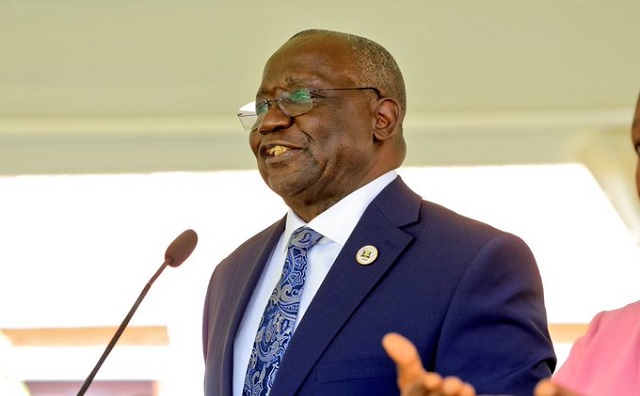
UNEB Executive Director, Dan Odongo
By Our Reporter
The release of the 2025 Primary Leaving Examination (PLE) results has reignited debate about the state of Uganda’s education system, after unusually high failure rates in Social Studies and Religious Education highlighted gaps in the transition to competency-based teaching and learning.
According to the Uganda National Examinations Board (UNEB), while overall performance improved compared to previous years, Social Studies emerged as the weakest subject nationally. Education officials attribute this trend largely to difficulties in implementing competency-based approaches, which emphasize application of knowledge rather than rote memorisation.
UNEB Executive Director Dan Odongo said the examination questions were deliberately set to test learners’ understanding of real-life situations and their ability to reason, analyse and apply concepts. However, many candidates struggled to respond effectively, revealing that classroom instruction in some subjects has not kept pace with changes in assessment methods.
...
UNEB Executive Director, Dan Odongo
By Our Reporter
The release of the 2025 Primary Leaving Examination (PLE) results has reignited debate about the state of Uganda’s education system, after unusually high failure rates in Social Studies and Religious Education highlighted gaps in the transition to competency-based teaching and learning.
According to the Uganda National Examinations Board (UNEB), while overall performance improved compared to previous years, Social Studies emerged as the weakest subject nationally. Education officials attribute this trend largely to difficulties in implementing competency-based approaches, which emphasize application of knowledge rather than rote memorisation.
UNEB Executive Director Dan Odongo said the examination questions were deliberately set to test learners’ understanding of real-life situations and their ability to reason, analyse and apply concepts. However, many candidates struggled to respond effectively, revealing that classroom instruction in some subjects has not kept pace with changes in assessment methods.
The competency-based curriculum is designed to equip learners with practical skills, critical thinking abilities and values relevant to modern society. But its success depends heavily on teacher preparedness. UNEB officials note that many teachers, particularly in humanities subjects, continue to rely on traditional teaching styles that prioritise note-taking and recall, leaving learners ill-prepared for analytical questions.
The 2025 PLE attracted more than 800,000 candidates, reflecting continued growth in primary school enrolment under Uganda’s universal education policies. While a higher number of pupils attained top grades, nearly one in ten candidates remained ungraded, raising concerns about learning outcomes at the foundational level.
Education stakeholders argue that the challenges exposed by the results go beyond examination design. Chronic shortages of trained teachers, large class sizes, inadequate learning materials and limited access to continuous professional development have constrained effective curriculum delivery, especially in rural and hard-to-reach areas.
In some districts, education authorities have responded to poor performance by introducing teacher assessments and intensified supervision. However, critics warn that punitive approaches risk demoralising educators if not accompanied by meaningful support, training and improved working conditions.
The PLE results have also drawn attention to examination malpractice, with UNEB confirming that results from several schools were withheld due to suspected irregularities. The board has described malpractice as increasingly organised and warned that it undermines the credibility of national assessments and distorts learning priorities.
Beyond primary education, Uganda’s broader education sector is undergoing a period of transition. The rollout of the competency-based lower secondary curriculum has already begun to reshape teaching and assessment at Uganda Certificate of Education level, where early results show gradual adaptation by both learners and teachers. Education authorities see lessons from this transition as critical for improving outcomes at primary level.
At the same time, Uganda continues to grapple with structural challenges in education financing. While government has prioritised access through universal primary and secondary education, funding constraints have affected infrastructure development, teacher recruitment and instructional materials. Education analysts argue that without sustained investment in quality, expanded access alone cannot deliver strong learning outcomes.
Gender disparities also remain a concern. Although girls continue to perform well in languages, boys recorded slightly stronger outcomes at the highest performance levels in the 2025 PLE. Officials say targeted interventions are needed to address subject-specific and regional gaps affecting both boys and girls.
UNEB leadership has called for a national conversation on assessment methods, with proposals to reform or move away from the long-standing aggregate scoring system that many believe fuels unhealthy competition and encourages malpractice. Advocates of reform argue that assessment should better reflect learner competencies rather than numerical rankings.
Despite the challenges, education officials maintain that the system is not in decline but in transition. They stress that competency-based education remains the right direction for Uganda, provided it is matched with comprehensive teacher training, adequate resources and consistent supervision.
As Uganda positions education as a foundation for economic transformation and workforce development, the latest PLE results serve as a reminder that reform at policy level must be reinforced by practical support in classrooms. Without that alignment, the promise of competency-based learning risks being undermined at the very stage where learning foundations are built.